It is important that you do not confuse taste with taste, since taste is a more complex sensation, in which, in addition to taste, the smell, touch, and temperature of the food influence. In fact, food does not taste the same when you have a cold, cannot breathe due to a blocked nose, or when you eat after the food has gone cold. The chemoreceptors of taste buds send nerve impulses to the brain where they are processed and translated into a sense of taste.
Although we can distinguish many flavors, they are really a combination of four basic flavors: sweet, salty, acid and bitter. As a curiosity, to say that recently confirmed the existence of more flavors, such as umami, the starchy (starched) and adipose (fat flavor).
Although these flavors are detected in all areas of the tongue, there are specific areas in which the taste buds better capture a certain type of flavor (or stimulus), so the tongue is divided into regions, according to the taste that is detected mainly.
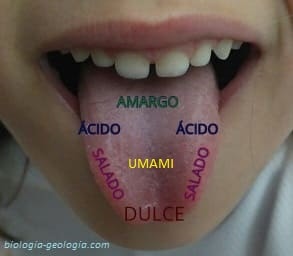
Experiment: The myth of the language map.
Practice: Map of the language.
Experiments with your body: The tongue.
Video: Sense of taste.

